
Defiant Praise

In the span of merely a week, I have had the solemn privilege of hearing some of the hardships facing those I love: concern over being able to feed one’s family for lack of financial resources, job changes and layoffs, life-altering diagnoses, far-flung ramifications of untimely deaths, and children in the direst of circumstances—emotionally, spiritually and physically.
“In this world [we] will have trouble…” (John 16:33 ESV)
Indeed, we will have trouble. Of this we are acutely, painfully aware. Jesus’ message to us is that we will never be alone in our tribulations, and that the victory is won, even if we only see it in heaven. I do find genuine comfort in that. As I try to bear up under the challenges facing my own household, while seeking to support and bless those around me in the midst of their hardships, I get hung up on how to live vibrantly, faithfully, and fully—here and now —in the face of those struggles. Without Christian platitudes.
Three simple letters hold the key.
I was entreated by a simple three-letter word in Habakkuk’s prayer: “Yet I will rejoice in the Lord.”
Yet.
The prophet was burdened and fearful, and perplexed by God’s perceived will. But he was moved from fear to faith through praise. Undaunted, tenacious praise. His praise for God flew in the face of his circumstances. It boldly proclaimed his faith would not be shaken. Choosing to rejoice in God in the midst of his circumstances girded him to stand firmly.
“Yet I will rejoice in the Lord.” I needed that simple word this week. It urged me to do what I felt unable to do: to praise God. When I am paralyzed of praise, laboring to utter any blessing back to the Lord, I am invited to use those penned by the psalmists. Their words siphon out of me the knowledge of God’s goodness that had been previously squelched by fear and frustration, confusion and concern; they draw a boundary no fear dare cross.
No matter the circumstance: God is sovereign and good.
No matter the sin: Jesus paid the price.
No matter the need: God is powerful and able.
No matter what this life brings: Jesus has overcome the world.
The burdens are many and heavy. Yet I will rejoice in the Lord. I will offer undaunted praise, in spite of all the pain I see and feel. Will you?
Though the fig tree should not blossom,
nor fruit be on the vines,
the produce of the olive fail
and the fields yield no food,
the flock be cut off from the fold
and there be no herd in the stalls,
yet I will rejoice in the LORD;
I will take joy in the God of my salvation.
GOD, the Lord, is my strength;
he makes my feet like the deer’s;
he makes me tread on my high places.
—Habakkuk 3:17-19 ESV
Recommended reading:
Hind’s Feet on High Places by Hannah Hurnard
Related music:
Check out Matt Redman’s “Blessed be Your Name”
Empty Handed
Help. Why (why!) is help so hard to ask for?
My husband occasionally travels for work, just two or three times a year. As a very involved husband and father, he’s always willing to pitch in for any need I have. So much so that when he’s gone, his helpful presence is definitively missed. During one of his rare travel weeks, I became aware that I had commitments to two children in three different locations on one night. There wasn’t time enough between the appointments to collect and drop off the right child at the right venue. I couldn’t pull it all off by myself, so I bit the bullet and tapped a few friends for some assistance. It was difficult to ask; I don’t like putting my responsibilities on another’s shoulders. I consoled myself with the notion that I’d gladly reciprocate in the future. They were gracious, and cheerfully arranged their afternoon and evening plans to support me.
This week, in a completely different situation, I had to ask for help again, but from different people and for different reasons. The need was much more significant, not merely a matter of being late to art class. It involved an enormous commitment of precious resources… resources that I don’t have and will never have.
I am unable to tranquilize the pain of my need with future reciprocity: I simply won’t be able to.
Though asking for help chauffeuring my kids was challenging, making this request was almost crippling. For me, the ability to reciprocate when asking for help seems to mitigate the condition of need. It makes me feel less needy, perhaps because my need appears limited in duration or nature. Where I feel able to repay, I am more willing to be indebted, if only temporarily. Where I am destitute of skill, time or money, I resist asking for help, because I am unable to give back. The pride of self-reliance, in other words, keeps me from seeking that which I genuinely need.
To receive Christ, we must, in humility, acknowledge our utter bankruptcy before God: I am sinful and in desperate need of a Savior. I have nothing to offer in exchange for my redemption from the judgment I justly deserve. I come to the Throne empty handed. And this is precisely how the Father intends it: that we are fully aware of our inability to earn the Grace, pay for the Gift. But God doesn’t stop at salvation and justification. Those events set in motion another work of the Holy Spirit: sanctification, the purifying process of becoming holy.
I struggled deeply to ask for help this week. I struggled even more profoundly to receive it. In and out of tears from the discomfort of my need, I slowly – too slowly – became aware this was something I needed to wrestle out and be purified of. God was pressing me to again be willing to acknowledge my poverty. Not for my salvation, but my sanctification. My discomfort in receiving the help I needed, but couldn’t repay, revealed a prideful independence, a lack of reliance on my Father. In humbly confessing my temporal needs to man, I would also confess my need to the Lord. The act of asking for help became a sanctifying work of the Spirit.
I want to more readily ask for help in the future, without promise of compensation, as fruit of this experience. I hope to see my needs as God’s tool to strip away another layer of my pride, purifying me and making me holy, set apart for His purposes.
In the emptiness of my upturned hands may I find the fullness of God’s sanctifying work.
On Duty
Most people dread it: the jury summons. The innocuous-looking little postcard informs us of an impending impingement on our preferred rhythms of life.
I got mine on August 10th. I had been slated as a prospective juror for this week, September 12-16. I filled out my juror questionnaire and received a juror reporting number. And then, I waited.
I waited until last Saturday to find out whether I had to report on Monday. I was deferred, and instructed to call at 5pm on Monday to find out if I would report on Tuesday. I waited.
Calling in on Monday night, I was put on stand-by, instructed to call at (but not before) 9:30a on Tuesday morning to find out if I was needed by 10:15a in room 4117. I waited.
I drove part way to the courthouse Tuesday morning and waited in a coffee shop, so I’d be close by if asked to report. At 9:30a, I called the number reserved for stand-by jurors. I was told they still didn’t know… they’d call me in 15 minutes. So, I waited some more.
I spent a great deal of time waiting to hear whether I would play a role in meting out justice. And yet, this is a role I’m called to fill every day of my life.
He has told you, O man, what is good;
And what does the LORD require of you
But to do justice, to love kindness,
And to walk humbly with your God?
–Micah 6:8 ESV
What the Lord requires of me. To do justice.
Justice —
that which is lawful, required; in accordance with a proper standard; doing what is right.
Not just lawful, more than that: doing what is right. And the standard for that isn’t my own. It’s God’s standard, because He is the God of justice (Isaiah 30:18).
Doing justice isn’t convenient. It costs something. In jury duty, it costs the juror the opportunity to earn their daily wages, or missing a child’s performance at school or athletic event. In the Christian life, the price can take many forms, financial or otherwise. As one who has been spared the wages of my sin, any cost seems too small. As long as I stop to think of it in those terms… His terms.
As I waited in the coffee shop, I was aware of a man who was clearly in need. His appearance revealed a need for money, but his behavior revealed an even greater need for companionship. He, too, was waiting. He was waiting to hear whether he’d be hired for a day labor job, and was eager to converse with anyone in the meantime. I am ashamed because I don’t know these things because I was willing to talk with him. I know them because I overheard his dialog with another latte-sipping, book-reading patron – one who was willing to do what I wasn’t.
I fell short of doing justice. I averted my eyes, my thoughts, when it was fully within my ability to meet his need by simply engaging with him. The cost to me was smaller than in almost any such situation: words and a smile. And yet I was still unwilling to make that simple sacrifice. I waited for my call to the Ada County Courthouse while I ignored the call to the next table.
I didn’t serve Ada County this week; my services were not required. Nor did I serve my God. And my services were very much required. My juror summons card now hangs on the bulletin board, the last thing I see as I walk out the door, sending me out to do justice every day.
One of my favorite organizations that addresses social justice: International Justice Mission
Braving the barn (a surprising lesson in friendship)
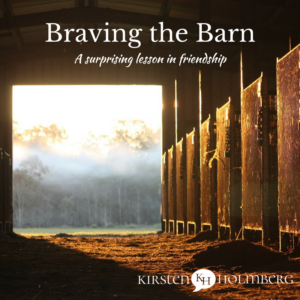 I love the statements in Proverbs: simple, true and packed with a punch, This one gave me some not-as-sweet food for thought:
Where there are no oxen, the manger is clean, but abundant crops come by the strength of the ox. –Proverbs 14:4 ESV
Hear my confession (and contain your gasps, please): The coat closet, the cargo area of my car, and the utensil drawer in my kitchen are each a mess. They may be contained behind closet, car or cabinet doors, but they are messes nonetheless (and not the only ones). Read More
Trust
 In making the rounds to garner back-to-school attire and supplies for my kids, stores issued many incentives to come back later and spend more money. I noticed, in particular, a $10 coupon from Old Navy which imitated our American currency, saying “In happiness we trust.” The underlying supposition, of course, is that buying clothes at Old Navy will make one happy.
My mind immediately flashed to the statement on our legal tender: In God we trust. I felt defensive not for the “almighty dollar” but for the Almighty Himself. For it is in Him we place our trust.
Or do we?
The word ‘trust’ in the Bible is used some 134 times, with slight variation and nuance to the meaning. Generally, it’s defined as hope, confidence or security. The unflattering truth is likely that we put a great deal of confidence and security in circumstantial happiness, evidenced by
– the desire to change jobs when we feel under-appreciated or under-paid
– switching schools at the first sign of hardship, socially or academically
– replacement of perfectly functional household goods, clothing and even body parts.
There are excellent reasons to do each of those things, but often those choices are driven by discontent, or unhappiness, assuming our pleasure alone is reason enough to precipitate change.
The price of trusting in circumstances or happiness is exorbitant and fickle, requiring ever-increasing payments. Much like the so-called coupon, to redeem it, we have to spend more.
Not so with the Lord. To trust Him is to have the enduring surety of a steadfast God, who can work all things out for our good (Romans 8:28). It is to know that He has great plans for our lives, even if our circumstances appear to say otherwise (Jeremiah 29:11). Most pointedly, it means giving assent to trials – counting them as privilege – because He wishes to refine our faith (James 1:2). Surely these reasons merit the placement of my hope, confidence, security – my trust – in Him.
I finished my errands, my wallet engorged with receipts and ‘invitations’ to spend more money, masquerading as opportunities to save. There are sound fiscal reasons to use cash instead of checks, debit cards or credit cards. Now I’ve found another, more compelling, reason: a tangible reminder, urging me to search whether it’s true of myself, “IN GOD WE TRUST.”
Command those who are rich in this present world not to be arrogant nor to put their hope in wealth, which is so uncertain, but to put their hope in God, who richly provides us with everything for our enjoyment.
–1 Timothy 6:17 (TNIV)
Jealousy, Scars, and Forgiveness
Everybody was happy. At least they should have been. Surrounded by food and friends, there was no cause for complaint. Except that there were siblings involved. My child became frustrated by the intrusion on time she preferred to share exclusively with her chum. Tears flowed; accusations were hurled. As a result, our time was cut short.
Once home, we talked. Accounts were reconciled. But the shame lingered in the heart of the offender. Together, we sat entwined in a chair as she cried. My heartache over the offenses were eased by her open admission and confession of the root of the problem: she had been jealous.
I’ve been reminded through my recent study of the Bible that God doesn’t anticipate we will live perfectly. Rather, He presses us to acknowledge our failures, to accept His grace and forgiveness, and to strive to honor Him.
We prayed together, asking for that forgiveness, and I was nearly crippled by the way she buried her face in my body – a reflection of that shame. I couldn’t help but think of Adam and Eve as they hid in the Garden, knowing I do the same.
Afterwards, as I sat with her, face to face, as she was finally able to raise hers after receiving God’s gift of grace. I wiped tears from her cheeks. She searched my eyes and found my grace, too. Still looking at me, she suddenly noted a scar on my face, near my nose. She asked what it came from, to which I honestly and ironically replied, “Jealousy.” I recounted the story of when I’d taken my sister’s coveted toy. I had attempted a get-away, became ensnared by the toy’s pull-string, tripped and fell, cutting open my face.
How good of God to use my physical scar for His purposes. How lovely that though I bear the mark of my sin, my Savior bore the consequences. I don’t have to hide my scarred face, instead He lovingly lifts my chin with His scarred hands and says, “I forgive you.”
Therefore, since we are surrounded by such a great cloud of witnesses, let us throw off everything that hinders and the sin that so easily entangles. And let us run with perseverance the race marked out for us, fixing our eyes on Jesus, the pioneer and perfecter of faith. –Hebrews 12:1,2a
Quail
 There’s a cute little variety of Quail here in Idaho. Cute, but absurd. Allow me to elaborate…
The variety that lives here has a little topknot that dangles overhead. They’re fairly unremarkable except for one distinct trait: they don’t fly. They’re capable, they just prefer not to fly. Though I’m certain they actually traffic in many other places, I most frequently encounter them in the road. As I approach in the car, the birds are ambling across the street. The closer I get, they shift into walking overdrive: leaning forward, jutting their little chins out, and scurrying as fast as their little feet can take them. The urgency of their crossing is palpable; cardiac arrest seems imminent. Instead of moved to compassion, I find myself mocking these avian sprinters: “You can fly, you ridiculous bird! You don’t need to run, you can fly!”
My husband theorizes the topknot keeps their eyes crossed and distracts them from all that’s going on around them. As is turns out, they’re pretty fast runners at a neat clip of 12 miles per hour.
After a recent near-squashing rant, I was rendered quiet by the similarities between me and these silly birds.
I’m just like a California Quail. They’re a ground-dwelling bird, and I’m a ground-dwelling human, until God takes me heavenward. I’m so focused on, and distracted by, the cares of my own life dangling overhead that I’m oblivious to the other beautiful gifts God is giving me and, worse, the needs of those around me. When I sense danger approaching, I, too, lean forward and simply try to run faster and harder.
A whisper in my heart: “Kirsten, you can fly. You don’t need to run; you can fly.”
“Even youths grow tired and weary, and young men stumble and fall; but those who hope in the LORD will renew their strength. They will soar on wings like eagles; they will run and not grow weary, they will walk and not be faint.” –Isaiah 40:30-31 NIV
God has made me capable of flight, on wings like eagles. Yet I choose not to.
So, my little neighbors will no longer be subject to my mockery, but rather a lovely reminder of this truth: I must put my hope in the Lord.
And then, I will soar.
Superlatives
 I recently spoke with a woman who has six children ranging from married to 10. Plus she’s been a foster parent to about nine more kids over the course of the years. I asked her about her parenting challenges and strengths. In the course of our conversation, she told me a story of when she’d been shopping at a thrift store about 10 years ago and saw a “World’s Greatest Mom” mug. She decided that she didn’t want to wait 20 years for her children to give her one, so she splurged and bought the 50 cent mug. Her oldest son was putting away the dishes the next morning and stopped, looked at the mug for a few minutes, and then asked, “Did you buy this for yourself?” It’s become a joke in their family and she routinely gets such items in mugs, t-shirts, and other various forms.
I’ve been ruminating on that story for the last few days. It puts a smile on my face when I think about it – I find it humorous. But, I’ve been really pondering the phrase “World’s Greatest Mom.” What makes a woman the best mom? In a child’s eyes, that mother would give them anything they wanted and would likely be more of a friend than authority figure. To be honest with myself, I’d love for my kids to feel that way about me. In an adult’s eyes, a woman is thought to be an excellent mother when she seems able to simultaneously embody patience in all circumstances, juggle an inordinate number of tasks, retain oodles of superfluous and substantial information, drive while passing out snacks, have an infinite supply of creative ways to entertain children, and (incredulously) look good while doing it.
In the end, I know it’s God’s eyes that matter. For Him to say that I am the “World’s Greatest Mom” would somehow be akin to hearing “Well done, good and faithful servant” (Matthew 25: 21, 23) for the only job I’ve found intrinsically satisfying. Ideally, if I do my job in such a way that I please and honor Him, then my children – as they mature into adulthood – would find themselves in agreement with God. But, I know I have no assurance of that. I really may come to the end of my days without the enthusiastic appreciation of my children. I hope not, but it’s possible.
The next time I see a mug or t-shirt or pin with that superlative description on it, I’m going to buy it. Not because I am. Not because I’ll ever be. Not because my kids agree. Not because they don’t. Not because they’ll buy it for me in 20 years with sincere feeling and I’m just giving myself an “advance.”
I’ll buy it because I want to be inspired to do my job faithfully, the very best I can.
Thankfully, I know my Inheritance is so much more than a mug… but perhaps I’ll also enjoy a nice cup of coffee with my Lord in heaven someday.
Whatever you do, work at it with all your heart, as working for the Lord, not for men, since you know that you will receive an inheritance from the Lord as a reward. – Colossians 3:23-24
Genesis
“In the beginning God…”
So the documented work of God commences in Genesis 1:1. But He was at work long before that. Before time, really.
This isn’t the beginning of my story. He was at work in my life, my story, long before I could – or would – see it. Now, I want to see it. I need to see it. I pray for eyes to see it. I don’t always, though. In fact, I often wonder how very little I do. How it feeds me and bolsters me when I catch sight of His handiwork. It merits documenting.
And so it begins. Come. Walk with me. Together, may we find God’s refining and redemptive work in that story.